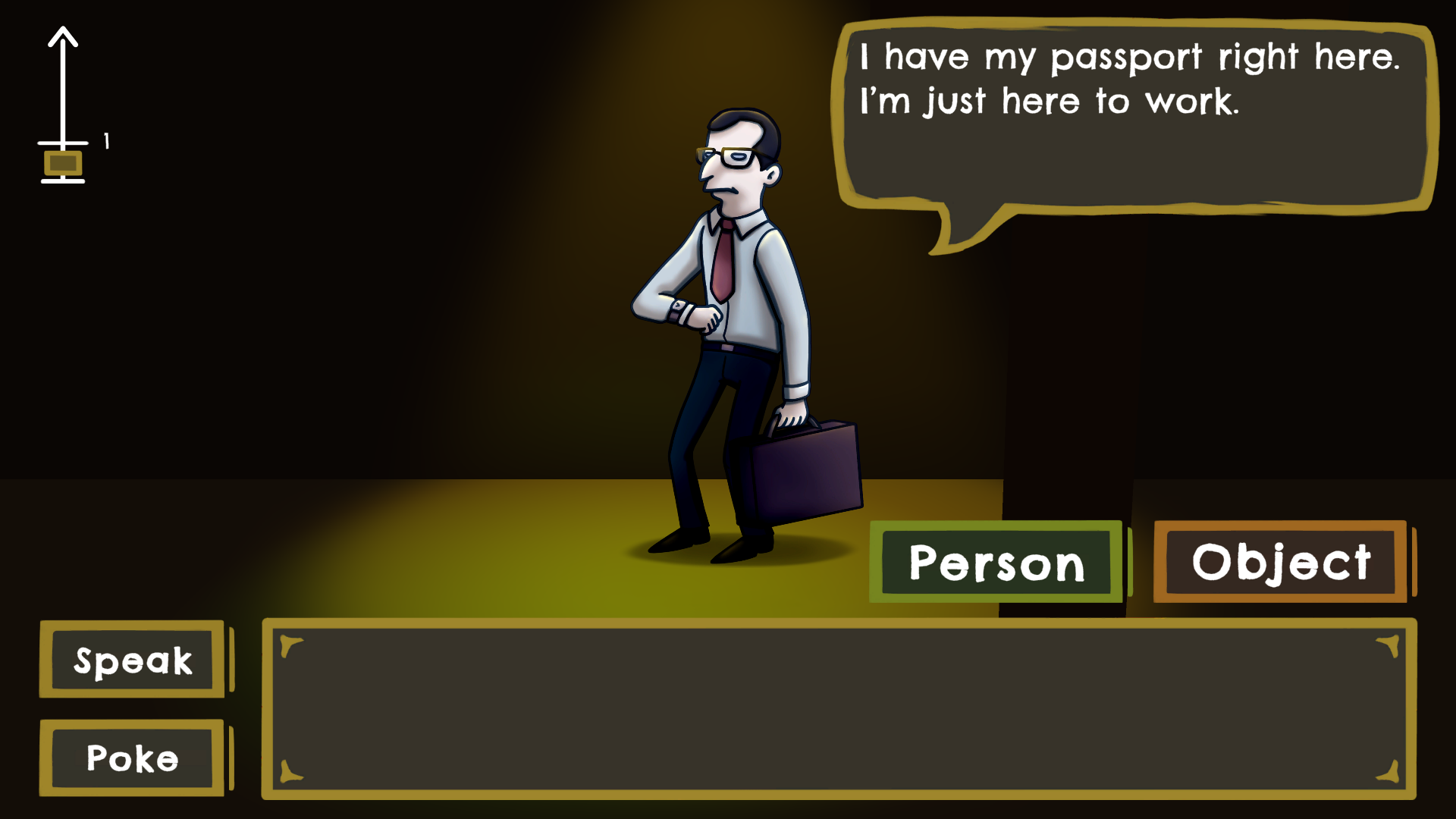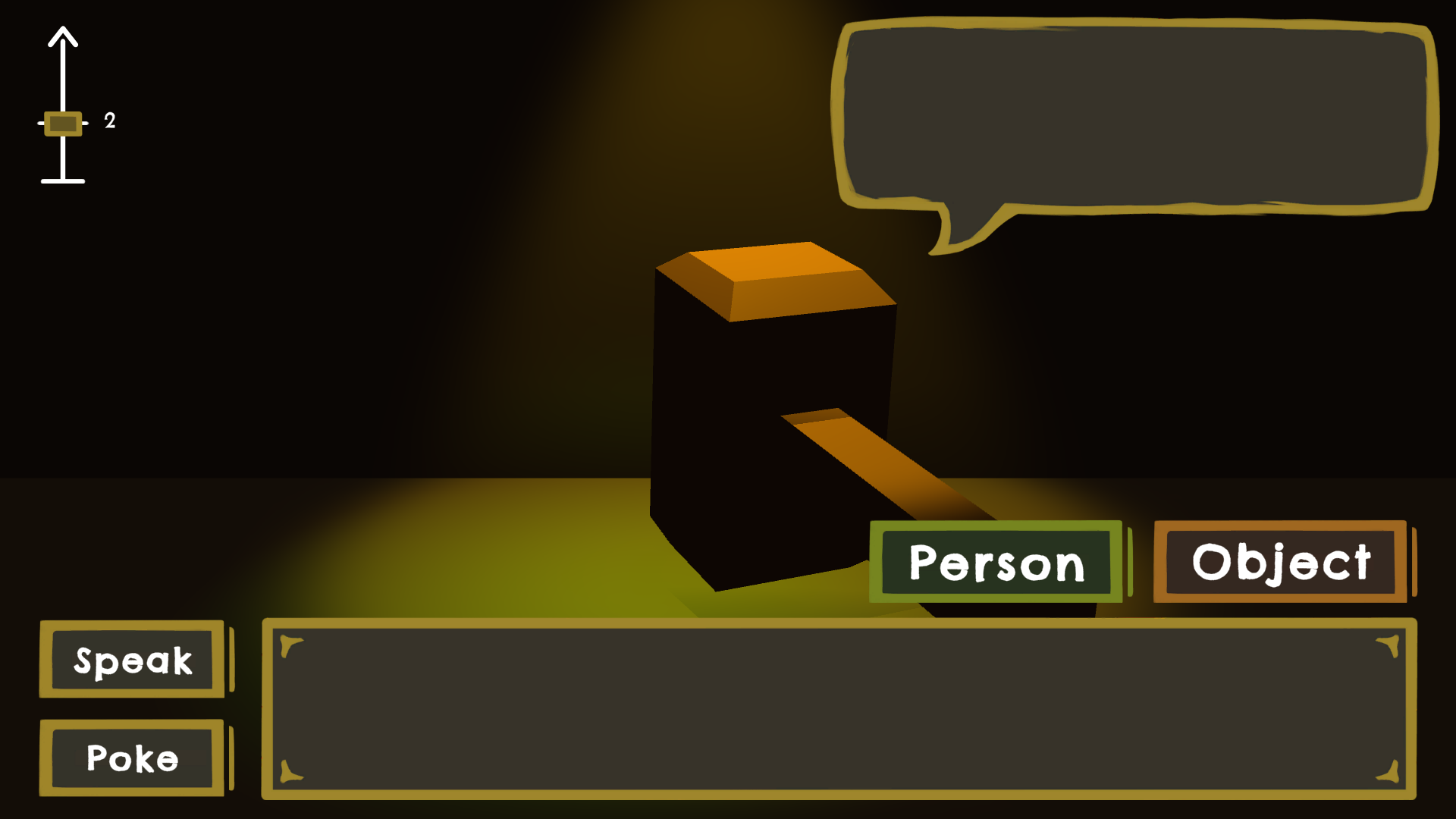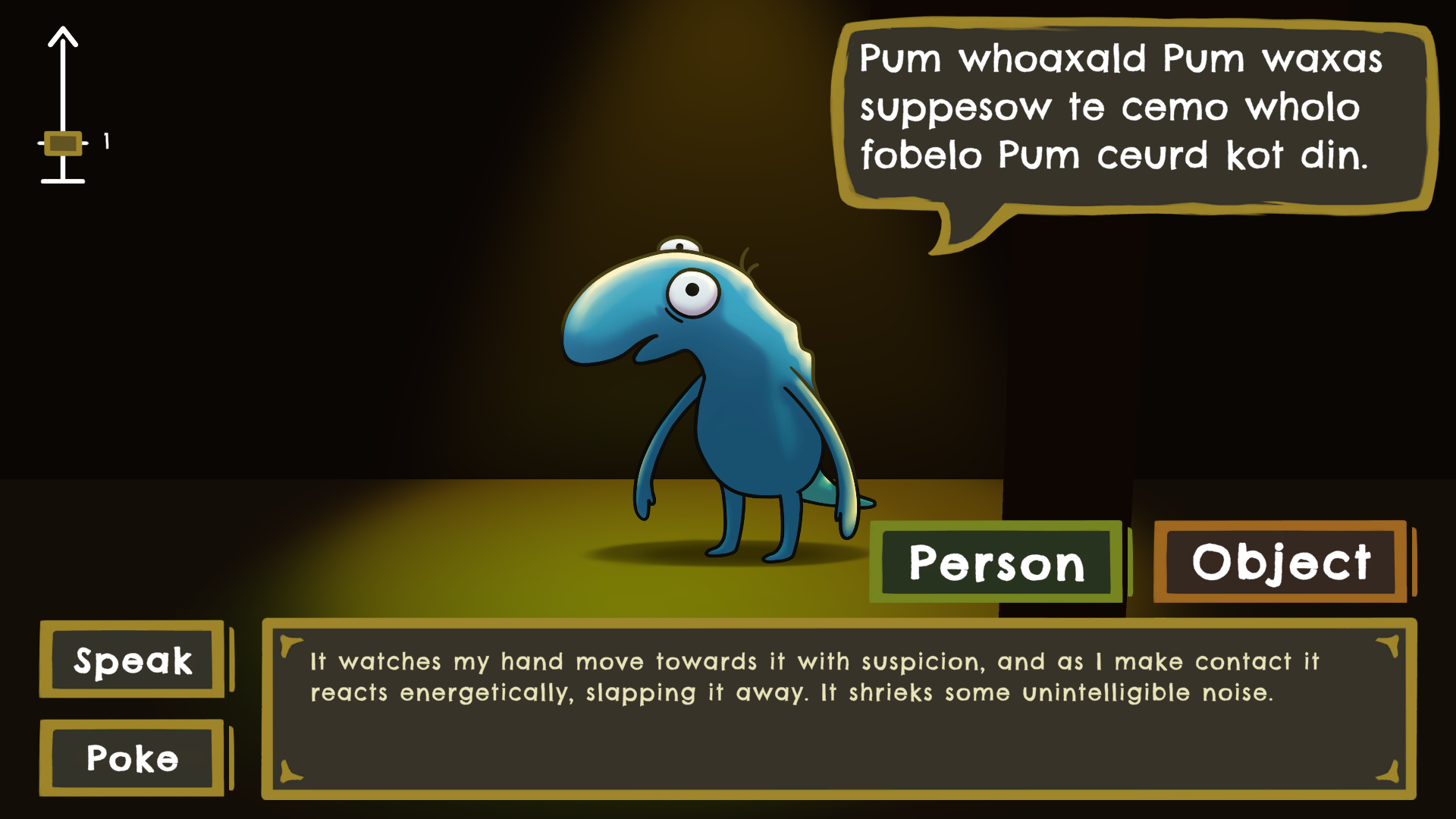

Individuopolis is a game where you have to examine fantastical creatures
and decide whether they classify as a person or an object.
In a distant, post-apocalyptic land, the exploitation of the planet caused
a global resource crisis, leading to the fall of almost all urban centers.
You are the official Inspector for Individuopolis, the only city left standing,
and it is your job to accurately classify all which attempts to cross its borders:
persons are allowed entry; objects are to be terminated and turned into resources.
A number of different creatures, referred to as “entisons”, will find themselves
before you, asking you to be granted access to the city. You will have to examine
and interact with them, to determine their level of consciousness and ultimately
decide their fate.
The game examines the problem of consciousness: from our external perspective,
it’s impossible to tell whether something truly is conscious, and it’s only the
conscious creature itself who can become aware of its own consciousness.
And yet, it’s only an external entity, removed from the specific experience of
the individual, that can classify the whole – and, in turn, feel the weight of
making such decisions.
Given the impossible nature of this question, the game never openly confirms
or disproves the player’s choices: the final answer is deeply personal and fully
dependent on individual perception, and thus should be left to the player.
The entisons, the creatures the player must classify, are intended to force
the player to reflect on specific themes and expand the scope of the basic
question to its extremes. As such, they are all wildly different from each other,
almost belonging to different universes entirely. They can resemble realistic
creatures, inanimate objects, and everything in-between.
Each represents a different example of life. The player is first presented with
a human life, one familiar and plausible, to serve as a starting reference and
point of comparison for the rest of the entisons. From there, more unusual forms
of life can follow: alien/incomprehensible life, animal life, plant life, organic life,
artificial life, and more ambiguous interpretations of the subject.
While all entisons were designed by loosely fitting them into one of three categories
(“person”, “object”, “ambigous”) for ease of planning and pacing, these definitions
never appear explicitly in-game. The only relevant classification is that determined
by the player themselves.
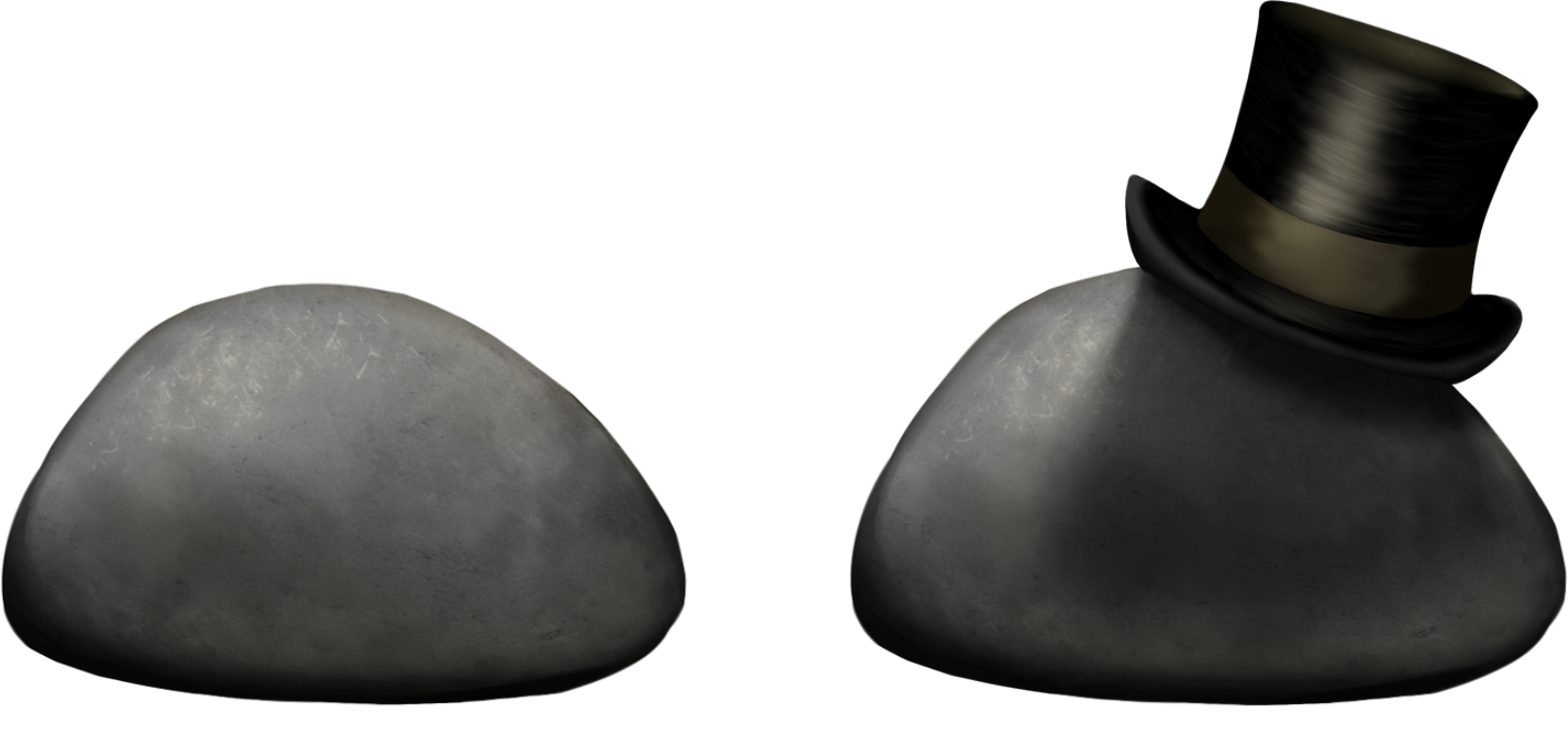
Pebbleton Jr. and Pebbleton Sr.
Pebbleton Jr. and Pebbleton Sr. appear one after the other. The former is a simple,
mundane rock, and doesn’t say a word: it follows our preconceptions of what an object is,
and so the player is naturally led to classify at such.
However, the mere appearance of Pebbleton Sr., who looks identical but bears a highly humanising feature
(a fancy hat) and openly inquires about its son, subverts that notion, recontextualising
the previous encounter entirely.
This exchange serves as a turning point in the player’s examination, as it shines a light on
our reliance on our expectations, and on just how quickly they can be influenced by mere details.
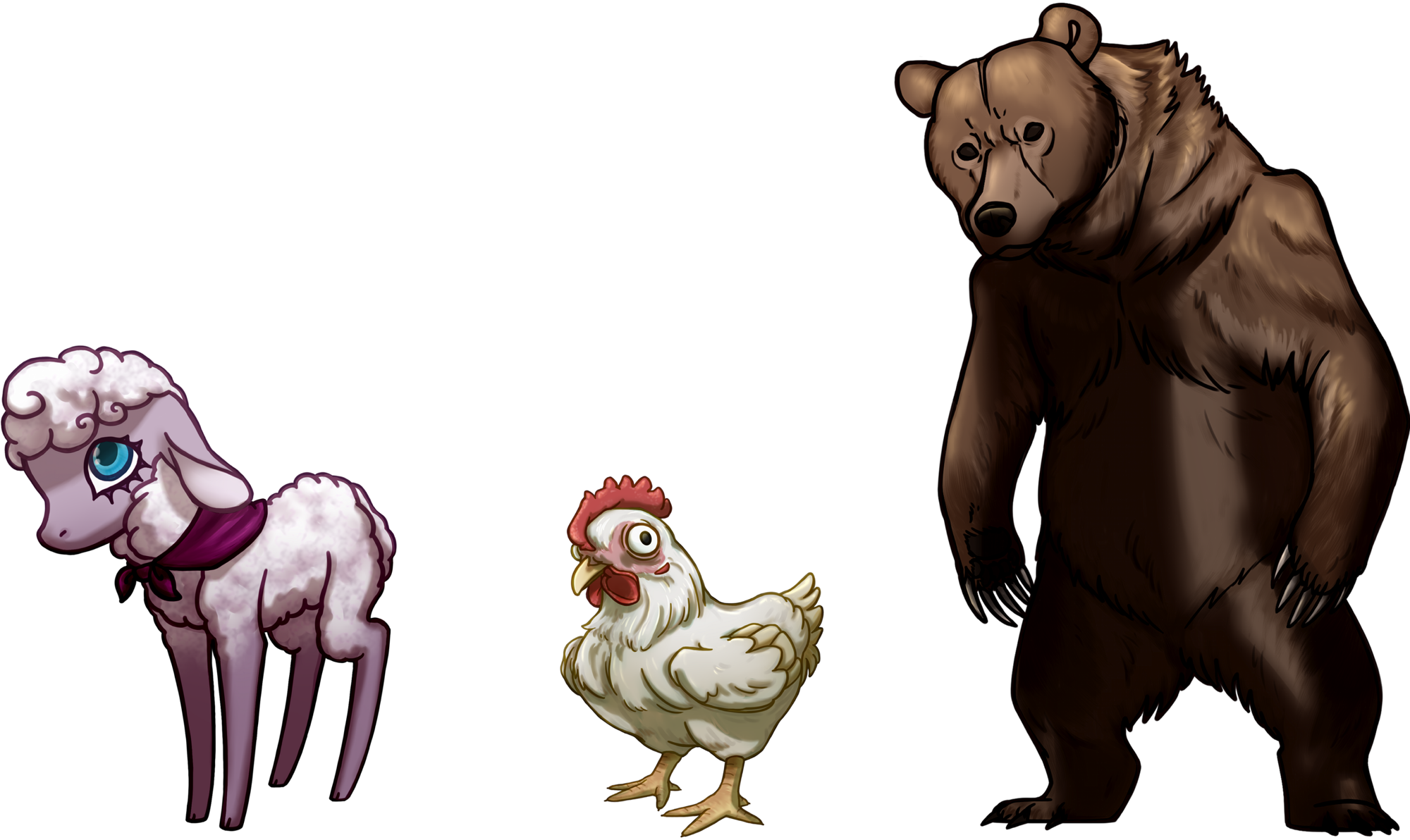
The Lamb, the Broiler Chicken, and the Bear
Amidst the entisons are a number of animals, ranging from highly humanised to highly dehumanised.
Playing on widespread stereotypes regarding their respective species, the Lamb is cute and articulate,
the Broiler Chicken appears dull and slow, and the Bear seems inscrutable and menacing – but all
are real-life animals.
The player is forced to confront their own biases and the consistency of their choices in the face
of significant variations in our cultural standards.
Since the main conflict of the game is based around a personal philosophical reflection,
it was essential to fully involve the player within the narrative, and ensure that each choice
they make is deliberate and carefully considered.
There is no time limit during the examination, as this allows the player to ponder each matter
seriously and have an internal debate entirely driven by their own personal values and perspectives.
The consequences of the player’s performance (that is, how many entisons they classify as objects)
are exclusively narrative: there is no hard fail state to be avoided, so as to not impose any
authoritative external judgement of the player’s choices. To this same end, the player is never
revealed whether their classifications of the entisons is accurate or not.
Player evaluation example
The game will try to subvert the player’s expectation and sow doubt in many ways, emphasising
the uncertain and unanswerable nature of the consciousness question, and will place the player
in the uncomfortable position of being the only person fully responsible for that final,
inevitably partial decision.
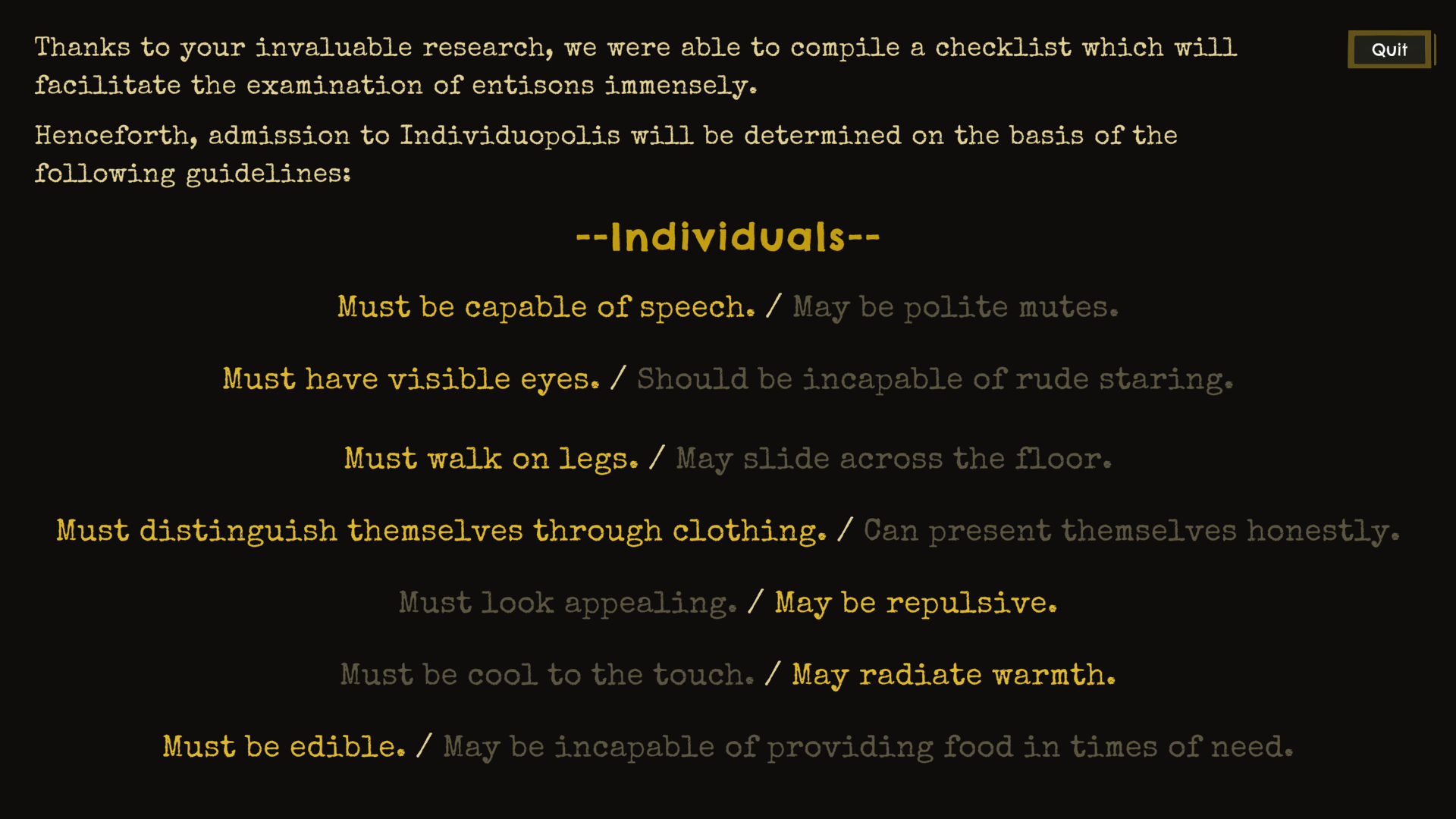
At the end of a playthrough, the player is shown a small, humorous evaluation of their choices,
in the form of a list of characteristics shared by all the entisons they classified as persons.
This is a lighthearted attempt to rationalise and standardize their decisions, which, in actuality,
will generally have been driven by a visceral intuition and personal experience, more than any
tangible quality of the creature in question.